.png)
← Back
Redefining Data Center Cooling Architecture
News
May 21, 2026

The Legacy of Traditional Data Center Cooling
For decades, data centers were designed around the assumption that air-cooled data halls, supported by mechanical refrigeration, were the most effective way to keep IT equipment within safe operating temperatures. These systems relied on large chiller plants supplying air handlers with water at temperatures as low as 6–7 °C.
This architecture worked well during the scale-out era of cloud and web workloads, when rack power densities typically ranged between 5–20 kW. However, it also embedded structural inefficiencies into cooling system design. Low temperature differentials (delta-T or ΔT) required higher water flow rates, increasing pumping energy and limiting overall system efficiency.
The emergence of high-density AI workloads has now exposed these inefficiencies. As rack power densities for the latest accelerators far surpass the cooling capacity of air, the switch to liquid and hybrid cooling has initiated a wholesale re-assessment of the operating conditions that maximize cooling efficiency.
The Shift to Liquid Cooling at Multi-Gigawatt Scale
Predictable performance gains from scaling laws have made massive compute investment the primary driver of AI breakthroughs, accelerating the shift from loosely coupled scale-out systems to tightly integrated scale-up architectures. This has fundamentally changed the thermal profile of the data center, pushing rack power densities to unprecedented levels. NVIDIA’s widely deployed GB200 platform has already driven rack densities to approximately120 kW, while next-generation systems like Vera Rubin are expected to push rack thermal design power (TDP) into the 180–220 kW range.
At these extremes, air cooling is no longer a viable solution. The physical limits of air as a heat transfer medium make it impossible to maintain GPUs within their required operating envelopes. By contrast, liquid offers orders-of-magnitude higher heat capacity—absorbing roughly 4,000 times more energy per unit volume than air—making direct-to-chip liquid cooling (DLC) not just advantageous, but essential.
This significant industry inflection point shift perfectly validates ThermalWorks' underlying architectural approach, proving that high delta-T system designs are the necessary foundation for where silicon is heading.
NVIDIA’s 45 °C Supply Dilemma
Thermal margin stacking has long been a challenge in mission-critical environments where risk tolerance is low. When a vendor specifies an operating temperature range for critical components like GPUs or compute trays, each downstream stakeholder—OEMs, integrators and operators—layers on additional safety buffers. The cumulative effect is a conservative system design that erodes much of the potential efficiency gain.
NVIDIA’s public validation of 45 °C inlet temperatures directly challenges this paradigm. By demonstrating that the silicon, packaging and cold plate designs are fully qualified to operate under these warmer conditions, it creates a pathway to unwind unnecessary thermal margins and unlock higher-efficiency operation.
However, capturing the benefits of a 45 °C supply introduces a fundamental architectural dilemma. Most data centers must still support a mix of liquid-cooled GPUs alongside air-cooled networking, storage and auxiliary systems. This hybrid reality forces operators into two suboptimal design choices:
As next-generation platforms like NVIDIA’s Vera Rubin move toward fully liquid-cooled compute trays, further reducing reliance on air-cooled components, these trade-offs will only become more pronounced. To maximize token-per-watt performance, AI data center design will need to prioritize hydronic loop conditions around DLC requirements—rather than constraining next-generation systems to accommodate legacy air-based infrastructure.
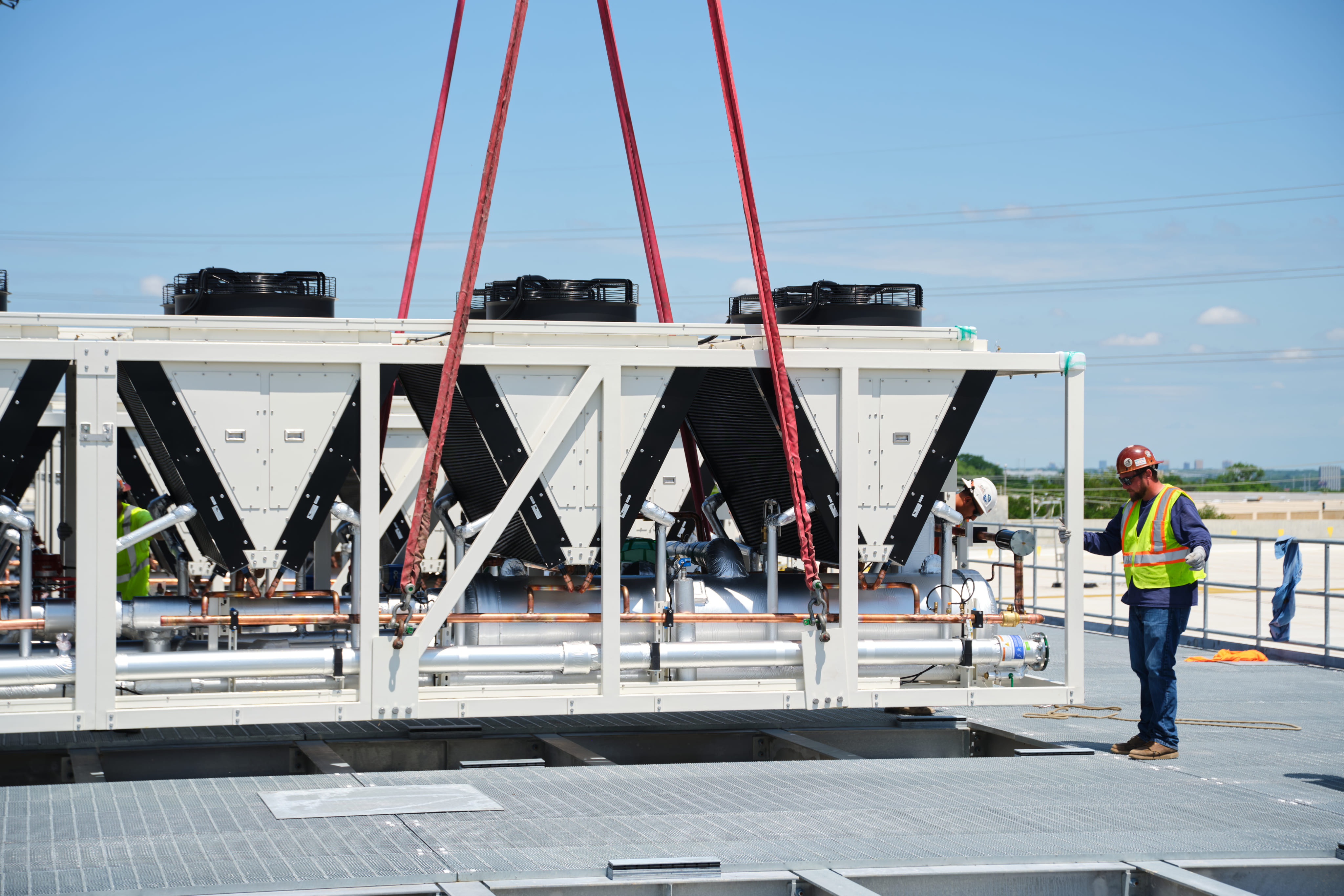
ThermalWorks has always enabled customers to late bind and optimize cooling infrastructure to deployed compute. Our products focus on eliminating inefficiencies that early stage, pre-determined decisions can introduce in an era of unprecedented silicon innovation. Our multi-function chillers were purpose built to consolidate dry (fluid) cooling, trim chilling and full mechanical cooling into a single adaptive platform that can simultaneously serve two independent temperature loops from a single unit. Now we have built on that capability to unlock a single facility loop solution for next generation AI workloads.
Introducing the Zone Chiller: Unlocking Energy Savings
ThermalWorks’ Zone Chiller is designed to address the architectural inefficiencies of single-loop systems by decoupling plant-level efficiency from the strict temperature requirements of air-side cooling.
Rather than forcing the entire chilled-water system to operate at legacy low temperatures—or investing in fully separate facility loops—the primary facility loop is optimized specifically for liquid cooling. It operates at elevated temperatures to maximize dry cooling hours, increase delta-T and minimize compressor runtime at the central plant.
Our Zone Chiller is then deployed locally within the building, using the warmer primary loop as its heat rejection source. This system generates the lower-temperature chilled water required for remaining air-cooled systems, without constraining the broader plant to inefficient operating conditions.
This architecture avoids the inefficiencies of legacy low temperature, low delta-T systems while preserving flexibility for mixed workloads. Extensive testing indicates that a Zone Chiller approach can deliver significant energy savings—around 30% compared to conventional chilled-water designs.
This approach unlocks the full benefits of the ThermalWorks system, creating a single platform architecture optimized for modern, DLC-first AI factories. For AI cloud providers, this delivers unmatched deployment flexibility by enabling cooling capacity to be configured and scaled on demand. By eliminating the rigid constraints of legacy cooling, this model accelerates time-to-first-token and maximizes operational efficiency at gigawatt scale.
To learn more about the ThermalWorks Zone Chiller, click here.